



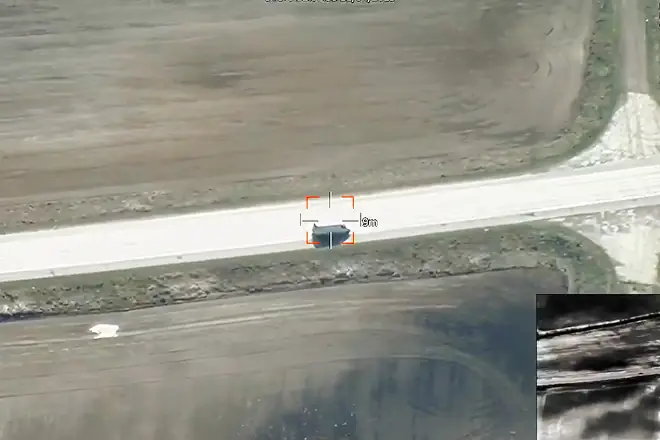
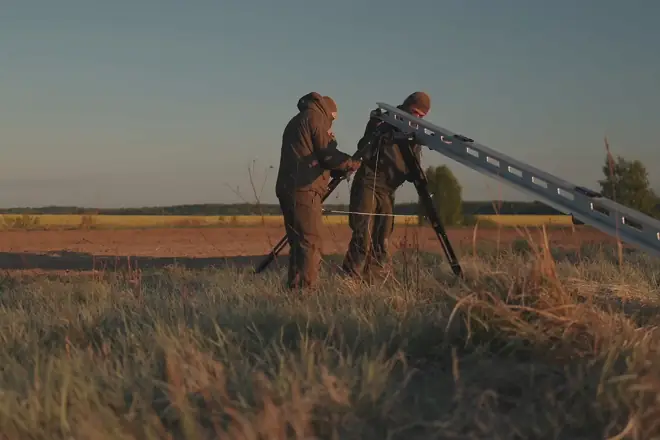

Ukrainian-born aviation production holding Skyeton has integrated a radiation sensor payload into its Raybird unmanned aviation system (UAS), expanding the platform’s capabilities for environmental monitoring, emergency response, and post-incident assessment missions.
The new payload enables real-time aerial radiation detection, mapping, and data transmission over extended distances, combining Raybird’s long-endurance performance with advanced sensing capabilities. The gamma radiation detection module is installed inside the UAV’s fuselage, ensuring aerodynamic balance, structural protection, and stable operation during long-duration missions. The system has been tested in the Chornobyl exclusion zone in Ukraine, validating its operational stability and measurement accuracy in a high-risk environment.
In 2025, Skyeton developed and delivered the first radiation sensor-equipped Raybird system to the State Emergency Service of Ukraine (ДСНС). Since then, the system has been on full operational duty, supporting continuous monitoring tasks and strengthening national emergency response capabilities.
Roman Knyazhenko, CEO of Skyeton: “Raybird has demonstrated its reliability in the most hostile conditions. We rely on it to help make our home safer, and the integration of radiation monitoring capabilities was driven by that very need. Today, it is part of the national emergency response system.”
The radiation sensor module is fully integrated into the aircraft’s onboard systems and ground control interface, enabling operators to receive real-time radiation data alongside standard flight telemetry.
Operational testing in the Chornobyl zone confirmed the system’s ability to:
- Conduct wide-area radiation reconnaissance
- Perform targeted hotspot detection
- Maintain stable data transmission over long-duration flights
- Operate reliably in varying temperature conditions
Beyond emergency response, the radiation monitoring configuration applies to disaster management, industrial safety oversight, infrastructure inspection, and post-incident environmental assessment.
Combat-proven in Ukraine with over 350,000 accumulated flight hours, Raybird continues to evolve as a modular airborne system capable of integrating high-value, mission-specific payloads while preserving its core operational advantage: long endurance combined with reliability.
About Raybird UAS:
Raybird is a small tactical unmanned aviation system designed for long-duration ISR and ISTAR missions.
Key characteristics (ICE version):
- Flight endurance: 28+ hours
- Maximum flight range: 2,500+ km
- Operating ceiling: 5,500 m
- Real-time data link: 220+ km, or unlimited with SATCOM integration
- Propulsion: EFI four-stroke gasoline engine
- Operating temperatures: -35°C to +55°C
- Deployment time: Up to 25 minutes
Raybird supports a wide range of interchangeable payloads, including multisensor EO/IR gimbals, aerial cameras, SAR systems, radio frequency locators, and specialized mission sensors such as radiation monitoring modules.